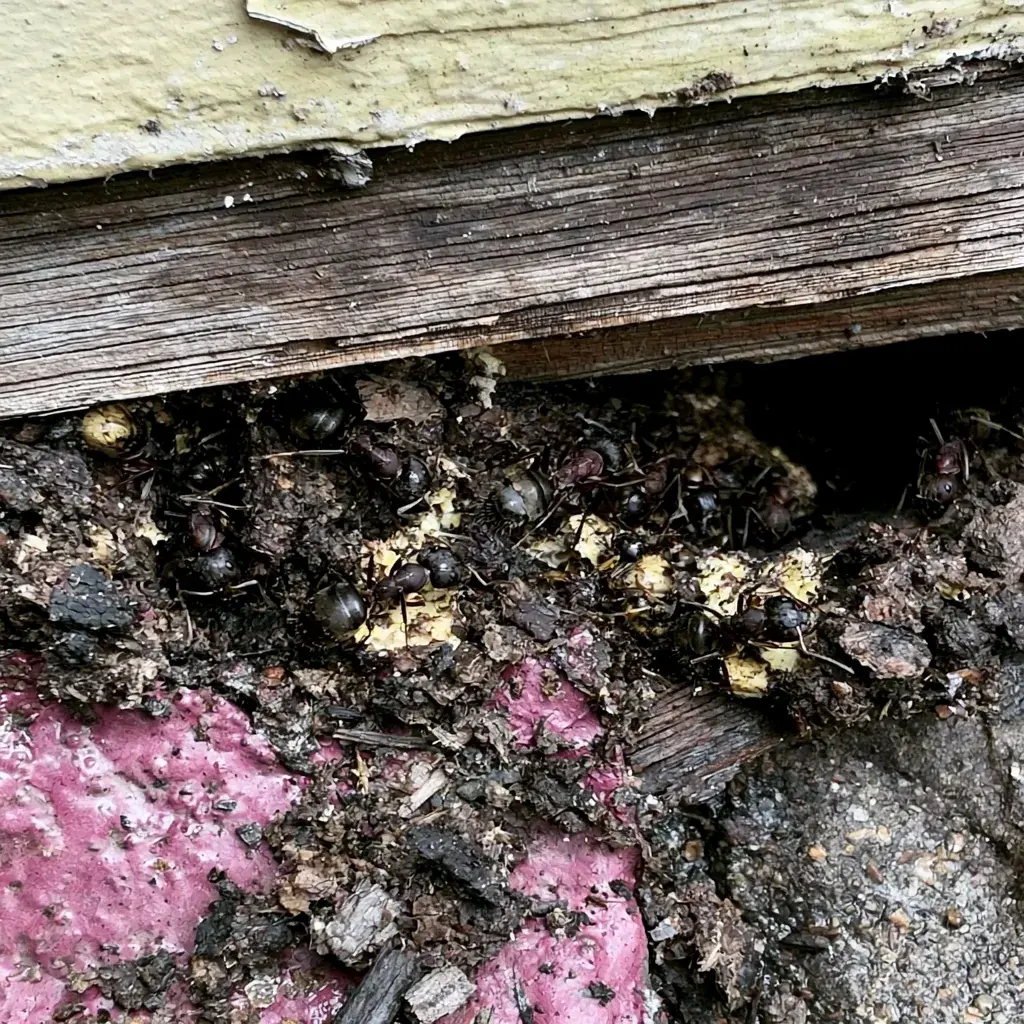
What a Treatment Actually Puts in Your House
Targeted placements and an exterior band, not a fog through every room.
Most people picture a fogged house. A current treatment looks nothing like that: small amounts placed into cracks, voids and bait stations where insects travel, plus a band along the outside of the foundation. Very little lands where a child crawls or a dog sleeps. Re-entry depends on the product chosen, so ask on the day, and ask what got sealed while somebody was under there.
Forget the fogging machine, that is not the visit
Ask around and you will get the same picture back: a machine at the door, mist rolling through every room, the family sitting in the car until evening. That version belongs to films and to houses treated decades ago. Whole room fogging coats surfaces people touch, reaches almost none of the places insects actually shelter, and survives now only for a narrow set of jobs. Tenting a whole building is structural fumigation, which sits in its own license category in South Carolina and is reserved for particular problems on particular structures. Neither of those is what pulls into a Conway driveway for a quarterly visit or a roach call.
The real thing is mostly walking, looking and kneeling, followed by small quantities put somewhere deliberate. Outside, a band along the foundation line, into weep holes, around door and window frames, beneath the siding lip and up under the eaves where mud daubers set up. Inside, material goes into gaps rather than onto surfaces: behind a switch plate, under the toe kick of a cabinet, into the void where a pipe passes a wall, along the hinge side of a drawer run. Gel bait is a bead about the size of a rice grain, tucked where nothing but a roach will find it.
Placement follows the housing stock, and that shifts once you head toward the coast. Near the Socastee Swing Bridge and the Intracoastal Waterway, older SC-544 neighborhoods sit low enough that the pros we connect you with favor gel and dust over sprays that just wash out. Cottages along Surfside's beach access streets get the same gap-and-crevice approach, scaled to smaller kitchens and shorter baseboards than a Conway floor plan usually has.
- Time spent on inspection first, including the crawl space, so the placements are aimed at something
- An exterior band and eave work, which is where most of the product on an average job goes
- Crack and crevice placements indoors, into voids and behind fixtures rather than across open floor
- Bait, in gels and stations, so the material travels to the nest instead of sitting where you live
- Physical work with no product at all: a torn vent screen, a gap at the hatch, a door sweep, mulch pulled back off the siding
Bait stations, and the dog that eats everything
Rodent bait belongs in a tamper resistant station, locked, anchored so it cannot be picked up and carried off, and set along a run outside, in the crawl space or in a garage corner rather than in the middle of the yard. The blocks inside are secured on rods so they do not spill out when the box gets knocked. That is the design, and it holds up well against a curious cat and an average dog. It does not hold up against every dog, because some dogs treat a plastic box as a project.
So say at booking what animals you have and what they get up to. A retriever that swallows things whole, a dog that digs along the curtain wall, or a beagle with crawl space access all change where stations can sensibly go, and a professional will happily switch to snap traps inside secured boxes, or move the whole program indoors and seal the entry points instead. Gel bait and insect stations follow the same logic: out of reach, in a void or behind a kick plate, never on an open floor. If a pet does get into any of it, call the vet and take the packaging or a clear photo of the label with you.
Bait placement matters just as much out toward Aynor and Loris as it does inside Conway, since both sit far enough out that a follow-up visit takes real drive time. Homes near the surrounding farmland outside Aynor, along US-701 near Loris, or tucked into the golf communities off SC-905 near Longs get the same rule: stations anchored where kids and pets can't reach them, checked on a schedule the pros we connect you with actually keep.
Re-entry is set by the product, so get it in hours
No honest website can print a re-entry time for your house, because that figure belongs to the specific product somebody chooses once they have seen the problem. What can be described is the usual shape of the answer. Liquid work on an interior surface generally means people and animals stay off it until it has dried. Dust and gel worked into voids does not normally put a whole room out of use. Exterior banding and eave work often has no bearing on the inside of the house at all, which is why so much of the job is done out there.
Ask three things when you book rather than on the day: which rooms are being treated, how many hours before those rooms are back in normal use, and whether you should open windows afterward. Then plan around it, a nap, a school run, the dog's walk, and have the technician write the product name and the re-entry time on the service ticket. If the product changes once somebody is on site, which happens, you should hear about it before it is applied rather than read it later.
Aquariums, cages, bowls and the baby on the floor
A fish tank needs planning because water is good at pulling things out of the air, and an air pump makes it better at it by pushing room air through the water all day. Cover the tank, switch the pump off for the period you are given, then switch it back on. Better still, ask whether that room can stay off the plan entirely, and in a lot of houses it can, because the insects are coming from the kitchen and the crawl space rather than from the room with the tank in it.
Birds are the animals worth arranging properly. Their breathing is efficient and their body mass is small, so a room that is unremarkable for a labrador is not unremarkable for a cockatiel. The same care goes for reptiles, rabbits, guinea pigs and anything else living in a cage that cannot walk away from a room. Where you can manage it, small caged animals leave the building for the visit rather than moving to the next room, and they go back once whatever you were told has passed.
Everything else is simply tidying, and it takes ten minutes. Pet bowls, mats and beds out of the treated room. Litter tray moved. Toys, pacifiers and bottles put away or covered. If a crawling baby uses a room, name that room out loud and ask for void and crack placement with no application to the floor, and pull the crib away from the wall if the baseboard behind it is on the plan. Afterward, the play blanket goes through the wash and hands get washed, which is sensible on any ordinary day anyway.
The mosquito yard, the tomato bed and the bees
Yard mosquito work is not a cloud sprayed over a lawn. It is a residual put onto the places adults rest through the heat of the day: the undersides of leaves, dense shrubs, shaded fence lines, the space under a deck, the vegetation along the ditch and the marsh side of the property. Water that cannot be tipped out gets a larvicide instead. Because the target is foliage, the treatment lands on plants, and that is exactly why the vegetable bed has to be part of the conversation before anybody starts filling a tank.
Flag the food growing areas and ask for them to be skipped or covered with a sheet. Harvest what is ready the day before. Move potted herbs and peppers indoors for an hour or two. Wash produce as you would anyway. Some labels carry specific directions about food crops and some products may not be applied to them at all, which is a second good reason to ask which product is going on the yard rather than accepting the phrase yard treatment as a description of anything.
Pollinators come down to timing and to open flowers. A treatment put out early in the morning or toward dusk misses the hours bees are working, and blooming shrubs, flowering clover in the lawn and anything in full flower should be left alone or mown down first so the heads are not there to be hit. Mention hives on your property or next door, mention the koi pond, the rain barrel and the bird bath, and mention any bee friendly planting you have deliberately put in. None of that stops the work happening. It changes where the nozzle points and what hour somebody arrives.
- Vegetable beds, fruit trees and herb pots pointed out on the day, or covered before the visit
- Ponds, water features, rain barrels and bird baths named, because water gets treated differently to shrubs
- Hives on your land or a neighbor's mentioned when you book, not when the tank is full
- Flowering plants and clover left out, or the lawn cut first so blooms are down
- Toys, paddling pools, dog bowls and cushions brought in off the grass
- An early or late slot requested if the yard is full of bloom in the middle of the season
Ask for the label, ask for the SDS, and ask what got sealed
Two documents exist and they answer different questions. The label is the legal directions for use, so it governs where a product may go, at what rate, and what has to happen before people and animals come back. The safety data sheet is a hazard and first aid document written mainly for the person handling the concentrate, and it is the one worth asking for when somebody in the house is pregnant, has asthma or another respiratory condition, is going through treatment that has left them run down, or when a nursery or a kitchen counter area is on the plan. Ask for the product name and for both to be emailed. A company that sends them the same afternoon has told you something useful about how it works.
If you are uneasy after a visit, be specific rather than general. Ask which product was used, exactly where it went, and for a copy of the ticket. Write down what you noticed, when, and in which room, because a precise note gets a real answer while a vague worry gets a reassurance. If anyone in the house feels unwell, see a doctor and tell them what was applied. If you believe a product was applied somewhere the label does not allow, that is a regulator matter rather than an argument with the office, and the page on checking a company covers where that goes.
Here is the part that gets left out of the sales conversation. The safest treatment on any house is the one that needs the least product, and that comes from unglamorous work rather than from a gentler chemical. A screen mended over a foundation vent, a sealed crawl space hatch, a door sweep on the garage, mulch pulled back off the siding, a downspout carried away from the curtain wall, a dried out crawl space. Every one of those cuts the number of insects arriving in the first place, so less has to be applied on the next visit and the one after that. Judge a company on how much of its first hour goes into finding those things, because that is where both the safety and the savings actually live.
Say all of this when you book, not on the doorstep
- Anyone pregnant, anyone with asthma or another respiratory condition, anyone with a sting allergy
- Every animal in the house, including fish, birds, reptiles and anything living in a cage
- Which rooms a baby or toddler uses at floor level, named room by room
- Whether the dog digs, chews plastic, or has a way under the house
- Vegetable beds, fruit, ponds, rain barrels and any hives on your land or next door
- That you want the product name and the re-entry time written on the service ticket
- What you will move yourself and what you expect the technician to work around
Frequently Asked Questions
Does the house have to be fogged or tented for roaches?
Almost never. Palmetto bugs and German roaches are handled with bait and targeted placement, because that is what reaches them where they live: inside cabinet voids, under appliances, behind plumbing, in the crawl space and along the exterior. Gel bait carried back to a harborage does more than any amount of mist in the open air of a kitchen. Tenting a building is structural fumigation, a separate license category with a narrow set of uses, and it is not what anybody should be proposing for a roach problem in a Conway kitchen. If somebody suggests it, ask what specifically requires it.
How long until the kids can be back in the room?
That comes from the label of whatever product is chosen, which is why a figure published in advance on a website would be a guess about your house. Ask before the appointment so you can plan the afternoon, and ask for it in hours rather than in reassurances. As a rough shape, interior liquid work usually means staying off the treated surface until it is dry, void placements and gels do not normally close a room, and exterior work often changes nothing indoors. Get the answer written on the ticket, and get told if the product changes on the day.
Our dog eats anything. Are bait stations a problem?
Say so when you book and it stops being one. Rodent stations are tamper resistant, locked and anchored, with the blocks held on rods inside, and that is enough for most animals. It is not enough for a dog that treats a plastic box as a chew toy or digs along the foundation to get at it. The practical answers are stations placed where the dog physically cannot go, snap traps in secured boxes, or dropping rodenticide altogether and putting the money into sealing the entry points. Any of those is a normal request. If a pet does get into bait, call the vet and take the label with you.
Can the yard be treated if we grow vegetables?
Yes, with the beds treated as no go areas rather than as an afterthought. Point them out, cover them with a sheet, or ask for a buffer around them, and pick anything ready the day before. Herbs and peppers in pots come inside for an hour. Some labels place specific limits on food crops and some products may not go near them at all, so ask which product is planned and what its label says about produce. Wash what you harvest as normal. The same conversation covers a fruit tree, a fig, a muscadine vine and anything a child grazes on while walking past.
Is a natural or botanical product automatically safer?
Not automatically, no. Botanical and mineral products are real tools with real labels, and some are a good fit indoors, but plant derived does not mean harmless, several are notable irritants, and a few break down so quickly that the job needs repeating more often, which can mean more applications rather than fewer. What reliably reduces exposure is method: inspect first, cut off the water and the food, seal the way in, then place the smallest amount needed exactly where it is needed. Ask about placement, quantity and what got sealed. Those three answers tell you more than the wording on the side of a truck.
Do we all need to leave the house while it is done?
Usually not, and if somebody insists you must, ask what is being applied that requires it. A typical interior visit is a technician working along baseboards, under sinks, into cabinet voids and behind appliances for half an hour, room by room, with the household simply staying out of the room being worked on. Exterior and crawl space work rarely needs anybody to go anywhere. Where a whole house does need to be vacated, that is a specific product decision with a specific timeframe attached, and you should be given both the reason and the number of hours before the appointment is booked.
Ask what gets sealed, not just what gets sprayed
Tell us who and what lives in your house, including the fish tank and the dog that eats plastic, and we will connect you with a licensed local pro who plans around it. Expect targeted placements, a written note of the product and the re-entry time, and a list of the gaps worth closing so the next visit needs less.
Call (843) 896-1048