Shavings on the vapor barrier
A small cone of gritty wood debris on the plastic sheeting directly under a joist or sill puts the gallery immediately above it. If it reappears after you clear it, the nest is active.
Active most of the year here, with swarmers and peak foraging in spring and early summer
Carpenter ants do not eat wood, they hollow it out to live in, and they overwhelmingly choose wood that has already been wet. In a house on a vented crawl space that usually means a sill plate, a band joist, a floor joist over standing water, or framing under a gutter that has been overflowing for a couple of seasons. Find the water and you have found the nest.
Most people call after noticing one of these.
A small cone of gritty wood debris on the plastic sheeting directly under a joist or sill puts the gallery immediately above it. If it reappears after you clear it, the nest is active.
Foragers travel a long way from the nest and come indoors for water and grease. Repeated night sightings in the same room narrow down which wall or which section of floor framing to open up.
Press the underside of the subfloor and the joists near any place water has been. Galleries follow the softer grain, so the wood feels spongy and can sound hollow when tapped.
The board bolted to the house behind a deck traps water and rots quietly for years. It is one of the most common nest locations in local construction and one of the least inspected.
A big colony working is audible in a quiet room, usually late in the evening. It sounds like paper being slowly crushed, and it comes from a specific spot rather than a whole wall.
The vented crawl space is the local reason this ant thrives. Under a lot of Conway houses the ground is damp, the air is humid most of the year, and the framing directly above it sits at a moisture content far higher than any lumber yard would allow. Add a torn vapor barrier, a slow supply line leak or a crawl space that puddles after a storm and you have soft, wet framing in the dark, undisturbed and out of sight, which is precisely what a colony needs to establish itself.
Above ground the story is drainage and trees. Gutters overwhelmed by pine needles and oak leaves overflow onto fascia and band joists, and the wood behind that stays wet through weeks of humid weather. Mature oaks and pines across older Conway neighborhoods also hold satellite nests in dead limbs, stumps and landscape timbers long before the house is involved. A limb resting on a roof, or firewood stacked against the siding, is often the bridge between the two.
Conway's flat, moisture-heavy ground keeps stumps and buried root systems soft year-round, which is exactly the condition carpenter ants favor before they ever reach a sill plate or a porch post. The pros we connect you with see the same pattern farther out too, from woodpiles near the SC-9 / SC-905 corridor to storm-damaged limbs in the surrounding woodland toward Longs, where standing water and rotting timber sit close enough to a house to matter.
Older neighborhoods around Conway carry plenty of mature shade trees and humid crawl spaces, exactly the setup carpenter ants look for once a sill plate or porch post stays damp too long. The same conditions turn up well beyond town too: low-lying lots near the Little River waterfront, damp stump fields around Aynor's farm edges, and shaded yards close to Forestbrook's creeks and wetlands all hold moisture against wood long enough to draw them in.
Homes in Longs, Murrells Inlet and Pawleys Island get treated for it on the same terms as Conway itself.
Termite swarmers. The spring swarm is where most people get this wrong, since both arrive as winged insects at a lit window. Three features settle it. An ant has a visibly narrow waist between its middle and rear sections; a termite does not, so its body reads as one straight tube. An ant's antennae are elbowed, a termite's are straight. An ant's rear wings are the shorter pair, while a termite carries four of matching length that shed at a touch. The debris is the fourth clue: gritty shavings mixed with body parts is ant work, whereas termites plaster their galleries with soil.
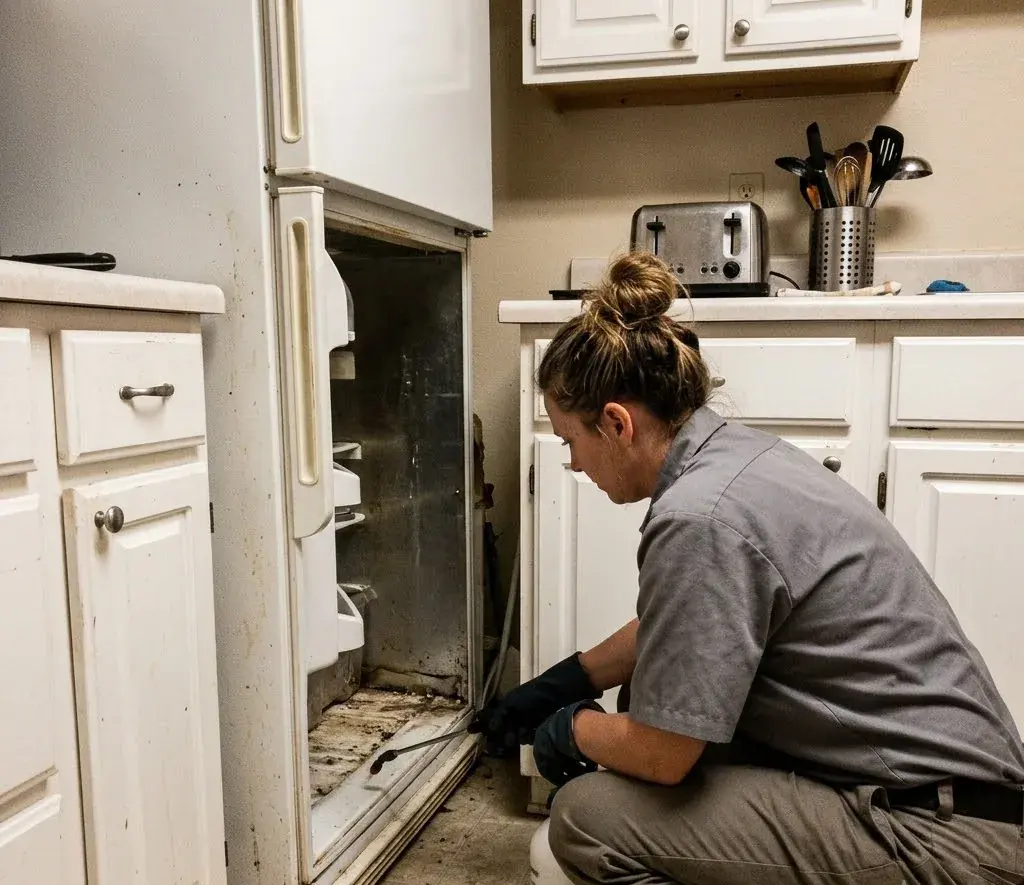
Finding the nest is the job, and the ants you can see are only the trailhead. That means going under the house with a light and a moisture meter, sounding sill plates, band joists and subfloor, checking the deck ledger, the fascia behind every gutter run, and any wall that has had a leak, then following foraging trails after dark to see which direction traffic comes from. It is patient work and it produces something more useful than a treatment, which is a list of the places water is getting into the structure.
Once the nest is identified, the treatment is a dust or foam injected into the void itself along with a slow acting bait that workers carry back to the queen. Anything that kills too quickly never reaches the part of the colony that matters, so speed is deliberately avoided. A follow up visit a few weeks later confirms the traffic has stopped. The part that decides whether this returns is the moisture: a nest treated in a sill plate that is still soaking wet in a humid crawl space is a nest that gets replaced, which is why crawl space drainage, a sealed vapor barrier and gutter repairs belong in the same conversation.
Whether carpenter ants wants ongoing cover comes down to the cause. Fix a route in and it is a job. Leave a damp crawl space and it is a season.
| How it presents | What that usually needs |
|---|---|
| A single event with an obvious source | One call, done |
| Back at the same point every warm spell | A scheduled plan |
| A route in that has clearly been used before | Treat, then seal the route |
The preventive half is genuinely worth doing yourself and it removes the reason they are there. Clear and guard the gutters, extend downspouts, cut limbs off the roof, move firewood and stored lumber off the siding, replace rotten trim rather than painting over it, and get the crawl space vapor barrier repaired and lapped properly. Where home treatment falls down is the nest. Retail sprays kill the foragers crossing a counter and never touch the queen, and a repellent product applied along a trail can drive satellite nests further into the framing, which makes the eventual job bigger. Anything involving structural framing or a wet crawl space is worth an inspection first.
Carpenter Ants normally comes in somewhere from an estimated $89 to $229, with access under the floor moving it as much as anything. Having somebody look costs nothing, and you see the number in writing first. See the pricing guide for the complete set of ranges, and this one is handled under General Pest Control.
The reason SC termite work is different. Formosan subterranean termites were introduced to South Carolina and are not native.
You feel it before you see it. You will be bitten before anything is visible, which is where the name comes from.
A turf problem, not a house problem. This one never comes indoors, and that is the point of the page.
Usually not as fast or as costly, but not harmless either. Termites consume wood continuously in very large numbers, while carpenter ants only excavate living space. The catch is that a colony working quietly in a wet sill plate or band joist for several years does real damage to structural members, and because the wood was already damp, you often find rot and ant galleries in the same board.
The ants you sprayed were foragers, and the nest that produced them was never touched. A colony simply sends out replacements, so activity returns in days or weeks. Worse, a repellent spray on a trail can push satellite nests deeper into the framing. Lasting control means locating and treating the nest, and then fixing the water that made that piece of wood attractive.
It is a stronger clue here than it would be in a cold state, but it is less conclusive. Our winters are mild enough that outdoor colonies do not shut down completely, so a few foragers indoors in January can still be coming from a stump or a woodpile. What does point indoors is steady activity in the same room, shavings accumulating, or sound in a wall, and that is worth inspecting rather than watching.
They prefer not to, but treated lumber that has been sitting wet for years, or that has begun to decay at a cut end or a bolt hole, becomes usable. Deck ledgers, posts set into the ground and the bottom of treated stair stringers are all places this shows up. Treated does not mean immune, it means slower, and moisture closes the gap.
One free inspection settles what it is and how far it has traveled. The estimate lands in writing before a technician starts.
Call (843) 896-1048