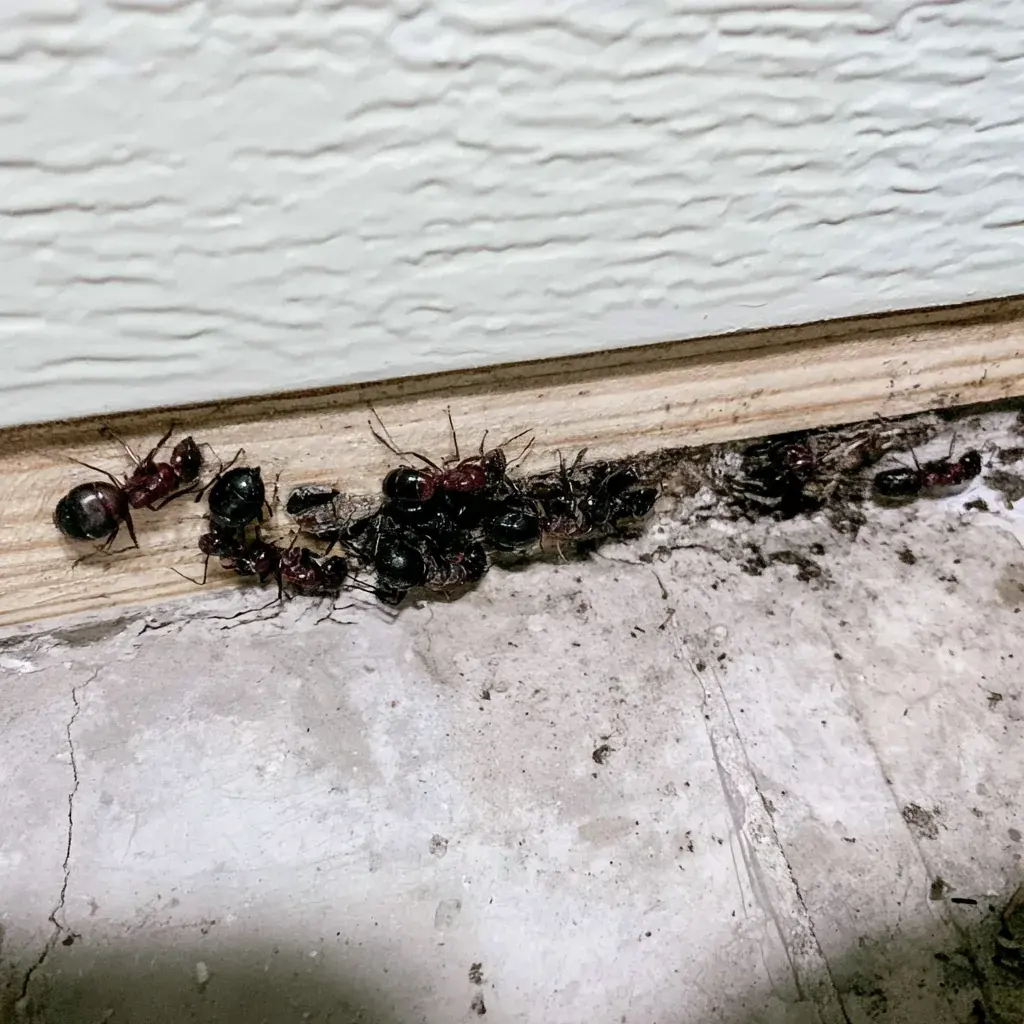
What a Termite Bond Promises, and What It Leaves With You in Conway
Re-treatment only against repair coverage, renewal, transfer, and the clauses that quietly end either.
A termite bond is a contract with the company that treated the property. It is not insurance, not a state document, and not a promise that termites will stay away. The line that decides its worth is whether it pays only to treat again, or also pays to repair new damage. Renewal, transfer and exclusions all hang off that one distinction. A general pest guarantee is something else entirely.
Ordinary paperwork on a house in this county
In parts of the country a termite warranty is an unusual thing to find in a closing folder. Here it sits alongside the survey and the insurance binder, and a house that has never had one raises an eyebrow rather than the other way around. The reason is straightforward. Two subterranean termite species work this coast, the eastern and the Formosan, the ground stays warm enough that colonies never take a real break, and a great many houses in Conway, Aynor and Loris sit on piers or curtain walls with a damp crawl space between the soil and the framing. Under those conditions a colony finding a house is not bad luck, it is a matter of time and geometry.
So the local question is rarely whether to have coverage. It is what the coverage says. Two documents on two houses down the same street can carry similar annual fees and mean very different things when something is found, and the difference is almost never visible in the marketing. It is in four places: the type of coverage, the renewal terms, the description of what was treated, and the list of conditions the homeowner is expected to maintain.
Coverage boundaries matter as much as coverage type, since a bond written for a house in Conway does not automatically follow the homeowner if the treated structure sits near a shared property line or an add-on room built after the original inspection. The pros we connect homeowners with out toward Carolina Forest see this most, where newer construction meets older infrastructure agreements, and the same gap turns up on renewals stretching toward Myrtle Beach and out along the US-701 corridor, where a bond's fine print rarely travels as far as its sales pitch did.
Re-treatment only against repair coverage
Re-treatment only is the common form, and it does what the name says. If termites are found in the covered structure during the term, the company comes back and treats again at no charge to you. That is genuine value, because a re-treatment on a crawl space house is not a trivial invoice. What it does not do is pay for a single board. If a colony has been quietly working a girder for two years before anyone notices, the treatment is covered and the carpentry is your problem.
Repair coverage, sometimes written as a damage warranty, adds the second half. It undertakes to repair new damage caused by covered termites during the term, normally up to a stated dollar limit and normally excluding anything that existed before the agreement started. It costs more each year and it is offered selectively, because a company will not write repair coverage on a structure it cannot inspect or on one with conditions it has told you to correct and you have not. That selectivity is informative in itself: if an operator declines to offer repair coverage on your house, ask why, because the answer describes the house.
Which to buy depends less on budget than on structure. On a slab house in a newer subdivision, damage tends to be found earlier and repair exposure is lower. On an older crawl space property where framing sits close to damp ground and half the substructure is awkward to see, repair coverage buys protection against exactly the scenario that makes people angry: damage discovered years after the last inspection said nothing was visible.
Conway's older neighborhoods aren't the only stake here, since the bond has to travel with the pros who honor it. A property near Bucksport along the Waccamaw River faces different soil moisture than one out toward Galivants Ferry on the Little Pee Dee, and a bond written without accounting for that gap in ground conditions is the one that gets contested later. The pros we connect you with write re-treatment terms that match the actual crawl space, not a boilerplate clause.
| Question | Re-treatment only | Repair coverage |
|---|---|---|
| Treats again at no charge | Yes | Yes |
| Pays to replace damaged wood | No | Up to a stated limit |
| Pre-existing damage | Not covered | Excluded and listed |
| Yearly renewal fee | Lower | Higher |
| Damage limit written in | Not applicable | Ask for the figure |
| Offered on any house | Usually | Only where conditions allow |
| Yearly inspection required | Yes | Yes, often stricter |
Renewal is the whole mechanism
A bond is not a one-time purchase with a long tail. It is an annual arrangement that stays alive because you pay the renewal and because the company gets in once a year to look. Expect an inspection tied to that renewal, and expect it to be a real one on a crawl space house, meaning somebody goes in with a light rather than signing a form at the door. Renewal on re-treatment only coverage commonly runs an estimated $65 to $135 a year, higher where repair coverage is included and higher again on a large or complicated footprint. Treat those as guide figures rather than quotes.
Letting it lapse is the expensive mistake, and it happens most often when a house changes hands or a bill goes to an old address. Coverage does not pause when you stop paying, it ends, and getting back in is not the same as catching up. A company asked to reinstate will normally want a fresh inspection, and if anything is found or if the treated barrier is old enough to be doubtful, it may require a new treatment at full price before it will write coverage again. Years of paid renewals do not carry across that gap. Set the renewal to autopay and put the yearly inspection in a calendar rather than trusting a mailed reminder.
Transfer when the house sells
Most bonds can move to a new owner and most do not move on their own. Transfer is a step: somebody requests it, a form is completed, a fee is usually paid, and the company frequently wants an inspection before it puts its name behind a structure for a different owner. Buyers should ask which company holds the coverage, whether it is current, what type it is, and what the transfer costs, and should ask during the inspection period rather than at the closing table. A transfer fee in the range of an estimated $50 to $100 is common, again as a guide.
Two details catch people out. The first is that a transfer can change the coverage. Where a repair warranty was written for the previous owner, some agreements pass on only the re-treatment portion to the buyer, so the document arrives looking familiar and covering less. Read what you are actually receiving. The second is that a lapsed bond cannot be transferred at all, which turns what looked like an asset in the listing into a fresh purchase. Confirm the paid-through date, in writing, from the company rather than from the seller's memory.
What quietly voids coverage
Nearly every dispute over a termite bond comes down to a condition the homeowner was told to maintain and did not, or a change to the structure nobody reported. None of these clauses are hidden, they are simply in a document people file and never open again. The pattern is consistent: a bond covers a treated structure in a described condition, so anything that alters the treated zone or reintroduces the conditions termites need can end the company's obligation.
The practical version is short. If you are about to change the ground around the house, add to the building, or you have found water where water should not be, call the company first and get the conversation recorded. A pier added under a porch, a slab poured for a shed against the wall, or a flower bed graded over the treated band are all reasonable things to do to a house and all capable of breaking a barrier. Handled in advance they become a small supplemental treatment. Discovered afterwards they become an argument.
- Building an addition, deck, porch or slab against the structure without having the new soil treated
- Grading, landscaping or new beds that disturb or cover the treated band around the foundation
- Wood, lattice, firewood or mulch placed in direct contact with soil against the wall
- A plumbing or roof leak left unrepaired after being noted, since sustained moisture is the condition the bond assumes you will correct
- Blocking the crawl space or refusing access, so the yearly inspection cannot be performed
- A missed renewal payment, which ends coverage rather than suspending it
- Applying your own termite product to the treated zone, or having another company treat it, without telling the bond holder
A general pest guarantee is a different promise
The word guarantee gets used for two unrelated things and it is worth keeping them apart. On a household pest plan, a guarantee is a service promise: if covered pests show up between scheduled visits, somebody comes back and deals with them without a new invoice. That is a good thing to have and it is the main practical reason to hold a plan at all. What it is not is a promise that no insect will ever enter the building, and any wording that implies otherwise is wording to distrust.
The useful test is whether the promise names a timeframe and a list. A guarantee that says we stand behind our work is a sentiment. A guarantee that says covered pests, listed on the attached schedule, re-serviced at no charge within a stated number of business days of your call, is a commitment somebody can be held to. Also check what sits outside it, because the exclusions on a general plan are fairly consistent: termites, bed bugs, wildlife in the attic, anything nesting in the structure, and stinging insects above a certain height are commonly quoted as separate work.
The lines to read before you sign either one
A bond is a legal agreement about a specific building, so the specifics are the document. The most overlooked field is the description of what was treated, along with the attached graph or diagram, because that drawing defines the covered structure. A detached garage, a screened porch on its own footing, an added sunroom or a shed on a slab may or may not be inside the line, and finding out afterwards is a bad way to find out.
Ask for the whole packet rather than the summary page, and read it before any money moves. A company comfortable handing over the treatment record, the diagram and the full terms in one go is showing you how it operates day to day. A company that would rather talk you through it at the kitchen table is also showing you something. The same goes for a household plan: the covered list and the exclusions belong attached to the agreement, not described. Anything important enough to argue about later is important enough to be written down now, while both sides are still being agreeable.
- The described treated area and the attached diagram, checked against every structure you expect covered
- Coverage type in plain words, re-treatment only or repair, and the damage limit if there is one
- The term length, the renewal fee, and whether the renewal price can rise and by how much
- What the yearly inspection includes and who is responsible for providing access
- The conditions you are required to maintain, listed rather than implied
- Whether Formosan termites and above-ground colonies are treated the same way under the terms
- The transfer process, the fee, and whether repair coverage survives a transfer
- How disputes are handled, including any arbitration clause, and how a claim is filed
Get these in writing, not verbally
- Coverage type: re-treatment only, or repair with a stated limit
- The paid-through date and who the renewal invoice goes to
- The diagram, and confirmation of which outbuildings are inside it
- The conditions you must maintain for coverage to stay valid
- Transfer fee and whether the coverage changes on transfer
- For a pest plan: the covered list, the exclusions, and the response time
Frequently Asked Questions
Is a termite bond insurance?
No, and the distinction matters if a claim ever happens. Insurance is a regulated product from an insurer. A bond is a contract with the pest control company that treated your house, so what you can claim, and from whom, is limited to what that agreement says and to that company's ability to honor it. Standard homeowners policies generally exclude termite damage as a maintenance issue, which is precisely the gap a repair bond is sold to fill. Read it as a service agreement with a repair undertaking attached, and judge the company as much as the paperwork.
Our renewal lapsed. Can we just start paying again?
Sometimes, but not as a simple catch-up. Once a bond lapses the coverage has ended, so reinstating is a new decision by the company rather than an administrative fix. Expect them to want a current inspection first. If evidence is found, or if the original treatment is old enough that the barrier cannot be relied on, they may require a fresh treatment at full price before writing anything, and the years you already paid do not offset it. If the lapse is recent, call immediately rather than waiting, because the conversation gets harder the longer the gap runs.
Does the bond transfer to us automatically when we buy?
Almost never automatically. Transfer is usually available and usually needs requesting, with a form, a fee often in the range of an estimated $50 to $100, and frequently an inspection before the company accepts a new owner. Do it inside the inspection period, not at closing. Ask specifically whether you are receiving the same coverage the seller had, since some agreements pass on the re-treatment portion only and drop the repair undertaking on transfer. Get the paid-through date confirmed by the company in writing, because a lapsed bond cannot be transferred at all.
Does a bond cover Formosan termites too?
Ask, and get the answer on paper, because this is a real question on this coast rather than a technicality. Formosan colonies get very large and can build carton nests above ground inside a wall or a tree, which is a different problem from a colony working up from the soil, and treatment can involve more than a soil barrier. Some agreements treat all subterranean termites identically. Others define coverage in terms of the treated soil zone, which is not the same thing when the nest is above it. The wording either says so or it does not, and if it does not, ask for it to be clarified before you sign.
What should we expect if we make a claim?
A structured process rather than a phone call and a check. Report it in writing as soon as you see something, keep the photos, and do not have another company treat the area first because that alone can end the obligation. The bond holder will inspect, decide whether the finding is covered termite activity inside the described area, and on re-treatment coverage will schedule treatment. On repair coverage the damage assessment is a separate step, usually with their own contractor and against the stated limit. Keep every renewal receipt and inspection report, since a claim moves faster when the record is complete.
Read the coverage type before you read the price
The gap between re-treatment only and repair coverage is where the money sits, and it is one line in a document. We will connect you with a licensed local pro who will inspect the structure, quote both, and tell you plainly which one your house justifies.
Call (843) 896-1048