Powder on the vapor barrier
Fine pale dust on the plastic sheeting or on stored boxes below a joist is the classic find. Because it sifts straight down, the pile tells you which board to look at.
Adults emerge mainly in the warm months, and damp framing supports them year-round
Small round holes in floor framing with a dusting of powder beneath them are the calling card of these beetles. The insect is real, but on this coast it is usually the second problem rather than the first. The beetles most often found in crawl space joists need damp wood, so what the holes are really reporting is a crawl space holding too much moisture.
These are the things homeowners spot before they call.
Fine pale dust on the plastic sheeting or on stored boxes below a joist is the classic find. Because it sifts straight down, the pile tells you which board to look at.
Infestations are often confined to a few members rather than the whole floor, which is useful: it usually means localized treatment and repair rather than wholesale work.
The single most useful test available to a homeowner. Anything reappearing over a few weeks of warm weather indicates larvae still feeding inside the wood.
Original heart pine and oak floors in older Conway houses can carry activity for years. Look along the seams and near a wall where the humidity is highest.
The beetles most often responsible in local floor framing need wood that is holding moisture, and published guidance puts the threshold at roughly thirteen percent wood moisture content before they will infest at all. A vented crawl space in coastal South Carolina spends a good part of the year well above that, because humid outside air entering a cool crawl space condenses rather than drying anything. Add a damaged vapor barrier or standing water after a storm and the framing above it stays wet enough to be habitable.
There is a second local route, which is the wood itself. Older Conway houses were built with heart pine and hardwood that can carry an infestation quietly for decades, and reclaimed lumber, salvaged beams and antique furniture brought into a humid coastal house sometimes arrive with larvae already inside. Once here, an unconditioned crawl space or an unheated storage room gives them conditions to continue in, while a properly dried space slowly makes the wood unusable to them.
Conway's older neighborhoods carry plenty of crawl space homes built before vapor barriers were standard practice, and that construction era is exactly where powderpost beetles keep finding untreated joists. The licensed pros we connect you with cover the same issue well outside town, out toward Loris along US-701 and SC-9, where farmhouses bordering tobacco-country farmland show identical exit holes in floor framing, and up near Longs along SC-905, where camps backing onto the Waccamaw River hold humidity a crawl space never fully sheds.
Older pier-and-beam construction around Conway gives powderpost beetles plenty of exposed floor joists to work through undetected for years, and that same construction style shows up well beyond the town line. Toward Aynor along US-501, farmhouses ringed by surrounding farmland often hide the same fine, powdery frass in sill plates, and near Little River, homes close to the marinas & seafood district off US-17 face it in salvaged or older dimensional lumber too.
We deal with this across Conway and the surrounding towns, Briarcliffe Acres, Bucksport and Galivants Ferry included.
Old, inactive holes and other wood borers. The question is never whether there are holes, it is whether anything is still in there. Clean out the powder, mark the area with a date, and check again after a few weeks in warm weather: fresh powder and a clean bright hole edge mean active larvae, while gray dust filled holes and no new frass usually mean an old infestation that ended when the wood dried. Termite work looks different again, since termites pack galleries with soil and leave no round exit holes at all.
The inspection is really a moisture survey with a beetle question attached. That means readings taken on the affected framing and on sound framing for comparison, a look at the vapor barrier coverage and lap, standing water and grading under the house, whether the vents are blocked or whether the space has been sealed and needs a dehumidifier, plus dryer and bathroom fans discharging where they should. Active and inactive holes get separated, and the affected members get mapped rather than described vaguely, because that map is what a repair estimate and any future report will refer back to.
Treatment then has two halves. A borate based product applied to bare accessible wood penetrates and makes the timber unsuitable for larvae, which is the standard approach for exposed crawl space framing, and badly weakened members get replaced by a carpenter rather than treated and left. The lasting half is drying the space: a properly lapped and sealed vapor barrier, drainage corrections, and in many local houses a sealed crawl space with a dehumidifier instead of open vents. Get the wood below the moisture level the larvae need and the problem stops being self sustaining, which is a better outcome than any spray schedule.
Plenty of powderpost beetles situations are done in one call. What decides it is whether the pressure came from an event or from conditions that are still there.
| What you are looking at | The fit |
|---|---|
| Something contained, in one part of the property | Treat it once |
| Pressure off the yard or the marsh, year after year | Recurring visits |
| Something living in the crawl space, a void or the attic | Treatment with exclusion work |
The diagnosis is the part a homeowner can do well. Vacuum the powder, mark the boards and the date, and watch for a few weeks to see whether anything is active at all, because a good number of these findings turn out to be old damage in dry wood. Moisture work is also fair game: replace or properly lap the vapor barrier, clear blocked vents, extend downspouts, correct grade that sends water under the house, and get the dryer vent discharging outdoors. What is not a DIY job is treating structural framing, judging whether a joist has lost strength, or deciding between venting and sealing a crawl space, all of which need someone under there with a meter and some experience.
Budget an estimated $99 to $239 for powderpost beetles locally, and treat that as a range to plan against rather than a price. Having somebody look costs nothing, and you see the number in writing first. See the pricing guide for the complete set of ranges, and this one is handled under Crawl Space & Moisture Control.
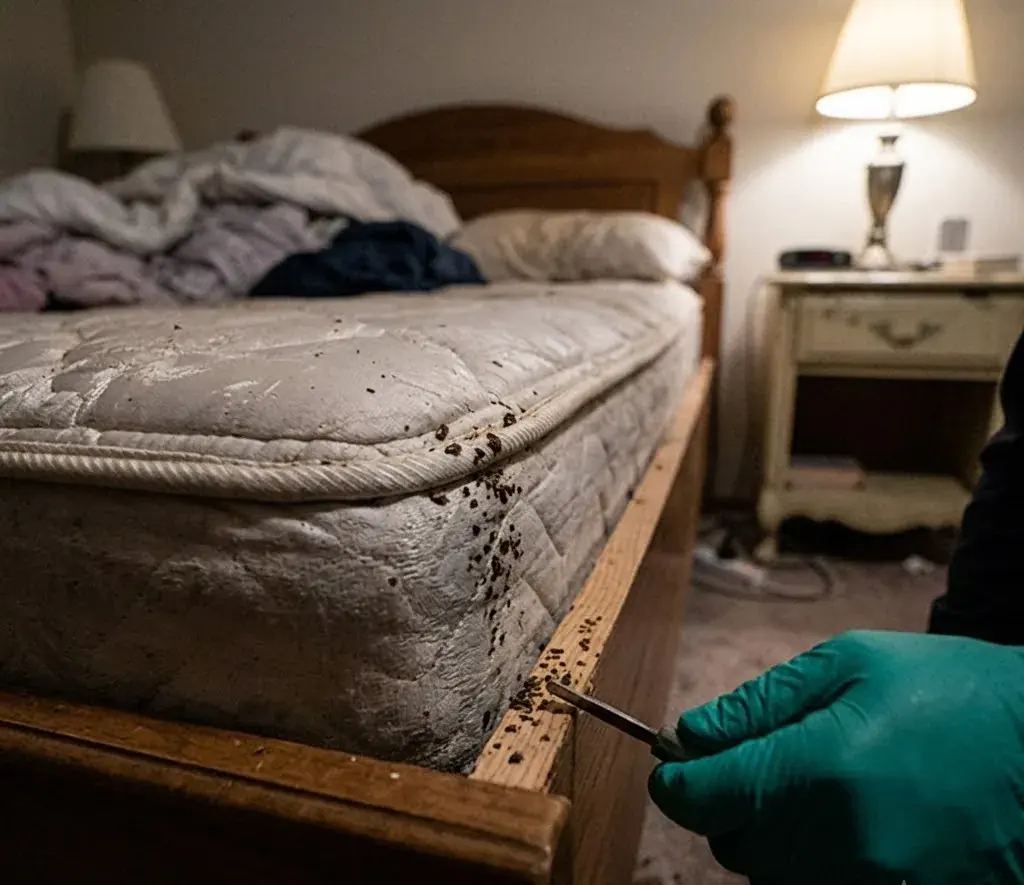
You feel it before you see it. You will be bitten before anything is visible, which is where the name comes from.
A turf problem, not a house problem. This one never comes indoors, and that is the point of the page.
Nothing to do with how clean you are. Start with the part people need to hear: bed bugs have nothing to do with housekeeping.
It rarely stops a sale, but it does need answering. In South Carolina the wood infestation report used in transactions, the CL-100, covers visible evidence of wood destroying insects and decay in accessible areas, and beetle holes in crawl space framing are a routine finding on it. What buyers and lenders want to see is whether the activity is current, what has been done about it, and whether the moisture that allowed it has been corrected. A documented treatment and a dried crawl space usually settles it.
For the crawl space and flooring cases common here, almost never. Fumigation is reserved for infestations that cannot be reached, such as activity spread through finished woodwork or valuable furniture. Framing you can see and touch is normally handled with a borate treatment to the bare wood plus moisture correction, which costs a fraction of a fumigation and addresses the cause rather than just the current generation.
For the species usually found in local floor framing, drying does most of the long term work, because below roughly thirteen percent wood moisture the wood stops being suitable. It will not remove larvae already inside a board, so treatment of the affected members still makes sense, and any timber that has lost real strength needs a carpenter. Think of it as treatment to deal with what is in there now and drying to make sure it does not come back.
Book an inspection at no cost. Naming it correctly is what decides whether the treatment holds, and nobody charges you for having a look.
Call (843) 896-1048